House Extensions and Building Services in Gloucester

House extensions, renovations, new builds, roofing and property maintenance across Gloucester, from a firm with every trade available. Find what you need below, or get in touch and we will talk it through.

House extensions in Gloucester

A house extension is usually the best way to get the space you need without leaving a street you like. Ace Group builds house extensions across Gloucester: kitchen extensions across the back of a semi, side extensions where a garage or a driveway used to be, and two-storey property extensions that add a bedroom above a bigger living space.

Extensions touch every trade. The ground is dug and the footings poured, the walls go up, the roof goes on, and then the inside has to be wired, plumbed, plastered and finished to match the rest of the house. We have all of those trades available, so one firm is answerable for the whole job.

Ask about a house extension

An extension build includes

  • A visit to look at the house, the garden and the access
  • Groundworks: footings, drains and the floor slab
  • Brickwork or blockwork to match the house as closely as it can
  • The roof, windows and doors, so the shell is weathertight
  • Knocking through, with the steelwork the engineer has specified
  • First fix, plastering, second fix and finishing

Worth thinking about early

  • Whether you need planning permission or can build under permitted development
  • Building regulations approval, which every extension needs
  • Drains and manholes in the way of the new footings
  • Neighbours: the Party Wall Act may apply near a boundary
  • Where you will cook and wash while the kitchen is out of use

The four usual types of extension

  • Single-storey rear

    Runs across the back of the house. The usual way to get a kitchen and dining room that opens on to the garden.

  • Side extension

    Uses the strip beside the house, or the place of an old garage. Good for a utility room, a study or a wider kitchen.

  • Wraparound

    A rear and a side extension joined in an L. Gives the most new floor space on the ground floor.

  • Two-storey

    Adds rooms upstairs as well as down, so you gain a bedroom or a bathroom for much the same footprint.

Your house The extension

Renovations and refurbishments

Not every home needs to be bigger. Often it needs to work better: a kitchen that is no longer cramped, a bathroom that is not thirty years old, floors that are warm and level. We take on renovations and refurbs from a single room to a whole house.

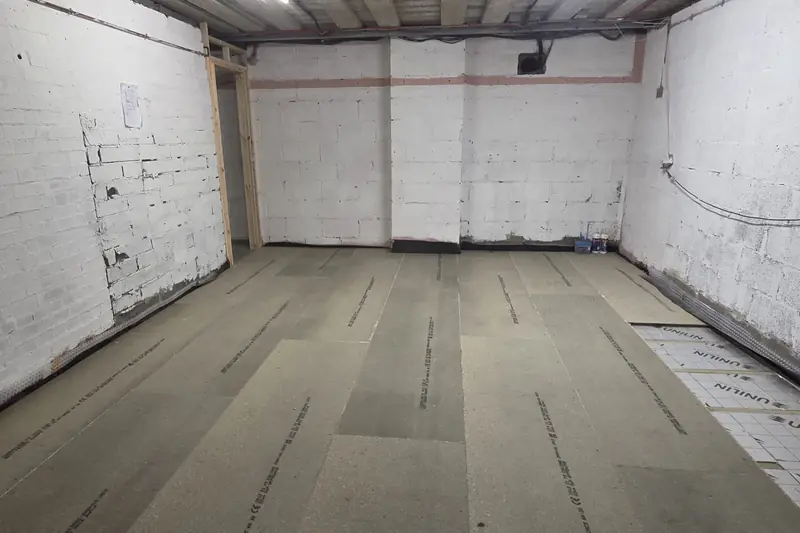
A renovation is often done alongside an extension, so the old part of the house is brought up to the standard of the new part. The photos show the kind of work involved: a finished laminate floor in one room, and new floor boards going down over insulation in another.

Ask about a renovation

Renovation work we take on

  • Kitchens and bathrooms fitted
  • Floors insulated, levelled and re-laid
  • Walls removed or moved, with the right support put in
  • Dry-lining and plastering
  • Rewiring and new plumbing
  • uPVC windows and doors

Good to know

  • Some of this work must be signed off under building regulations, such as new electrics in a bathroom or taking out a load-bearing wall
  • Older Gloucester houses can hide surprises behind the plaster, so allow a little slack in the budget
  • Doing the messy work in one go costs less than doing it room by room
New oak-effect laminate floor laid in a freshly boarded room, with a double socket on the wall
A finished laminate floor in a room in Cheltenham.
New floor boards laid over insulation in a white-painted block-walled room
Floor boards down over new insulation.

New builds

A new build is an extension without a house to lean on: the same trades in the same order, with more of everything. We build new homes on plots and garden land, and smaller new buildings such as garages and annexes.

You will normally come to us with planning permission and drawings in hand, or with an architect already working on them. We build to those drawings, work with the building control inspector at each stage and keep you up to date as the building comes out of the ground.

Ask about a new build

The order a new build goes in

  • Groundworks: site strip, footings and drains
  • Brickwork and blockwork up to roof level
  • Scaffolding, roof structure and roof covering
  • Windows and doors, so the building is dry
  • First fix carpentry, electrics and plumbing
  • Dry-lining, plastering and second fix
  • Kitchens, bathrooms, decorating and landscaping

Before work starts

  • Planning permission, with any conditions the council has attached
  • Building regulations drawings and an appointed building control body
  • A structural engineer’s design for the footings and any steel
  • Services: water, drainage, electricity and gas connections take time to arrange

Trades we have available

  • Groundworks
  • Brickwork
  • Scaffolding
  • Roofing
  • Dry-lining
  • Plastering
  • Electrical
  • Plumbing
  • Carpentry
  • Kitchens
  • Bathrooms
  • uPVC windows and doors
  • Landscaping

Roofing

Every extension needs a roof, and a lot of older extensions need a new one. Roofing is one of our own trades, so the roof on your extension is built by the same firm as the walls under it, and we take on roofing as a job in its own right too.

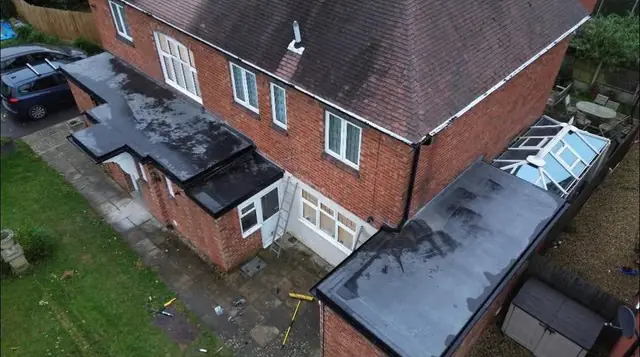
The photo was taken from a drone over one of our jobs: a red-brick house with new flat roofs over its single-storey side and rear. A flat roof done properly has a slight fall so rain runs to the gutter, and it is sealed carefully where it meets the house wall, because that joint is where old flat roofs most often leak.

Ask about roofing

Roofing work we take on

  • Flat roofs on extensions, garages and porches
  • Pitched, tiled roofs to match the main house
  • Old felt roofs stripped and replaced
  • Fascias, soffits and guttering
  • Roof repairs

Signs a flat roof needs attention

  • Water that sits in pools long after rain
  • Blisters, splits or lifting edges in the covering
  • Damp patches on the ceiling underneath
  • Flashing that has come away from the house wall
Drone view of a red-brick house with new dark flat roofs over its single-storey side and rear, a ladder against the wall and a conservatory beside it
New flat roofs on a red-brick house, seen from above.

Property maintenance

Property Maintenance & Management is the line under the Ace Group name, and it is a large part of what we do. Homeowners call us for the jobs that are too big for a handyman and too small for most builders. Landlords use us to keep rented houses in good order between and during tenancies.

Maintenance covers the outside as well. The patio in the photo is porcelain paving we laid behind a newly built house: the ground dug out and levelled, then large slabs set to a fall so water runs away from the wall.

Ask about property maintenance

Typical maintenance jobs

  • Brickwork repairs and repointing
  • Gutters, fascias and small roof repairs
  • Plastering and making good after leaks
  • Doors, windows and carpentry repairs
  • Patios, paths and fencing
  • Getting a rented property ready for the next tenant

Who we work for

  • Homeowners with a list of jobs to clear
  • Landlords with one property or several
  • Buyers putting a house right before they move in
  • Sellers smartening a house up before it goes on the market
Large cream porcelain paving slabs laid behind a red-brick new-build house under a blue sky, with bulk bags of materials on the bare ground beside it
A porcelain patio laid behind a house in Swindon.

Before you start

Four things to settle before extending a house in Gloucester

Property extensions are regulated building work. These four questions are worth settling before anyone picks up a spade.

  1. Do you need planning permission?

    Many house extensions can be built under permitted development, which means no planning application, but only within limits on size, height and position. Flats, maisonettes, listed buildings and homes in a conservation area have fewer rights or none. Gloucester City Council’s planning team can tell you where you stand, and a lawful development certificate gives you that in writing.

  2. Building regulations always apply

    Planning permission and building regulations are separate things. Every extension has to meet the building regulations for structure, insulation, fire safety, drainage and electrics, and is inspected as it goes up. Keep the completion certificate: you will need it when you sell.

  3. Is there a shared wall or boundary?

    If you build on or near the boundary, or cut into a wall you share with a neighbour, the Party Wall Act is likely to apply. You have to give your neighbours written notice before work starts, so it is worth talking to them early.

  4. What is under the garden?

    Drains and sewers often run across the back of houses, exactly where an extension wants to go. If you build over or close to a public sewer you need the water company’s agreement first. In Gloucester that is Severn Trent.

This is general guidance for England, not advice on a particular property. Your council and building control body make the decisions.

FAQs

Questions about extensions and building work

What is the difference between planning permission and building regulations?

Planning permission is about whether you may build: how the extension looks and how it affects the neighbours and the street. Building regulations are about how it is built: that it is safe, dry, warm and sound. You may not need the first, but you always need the second.

Should the extension roof be flat or pitched?

A pitched, tiled roof matches most houses and sheds water well, but it needs height, which can be a problem under bedroom windows. A flat roof is lower and suits roof lanterns and wide openings. Both work well when they are built properly.

Do I need an architect before I contact a builder?

You will need drawings for building regulations, and for planning if it is required, from an architect or an architectural technician. It is still worth speaking to a builder early, because we can tell you what is practical on your plot before you pay for a design.

Can you match the new brickwork to my house?

A close match is usually possible, by choosing a brick of the same size, colour and texture and copying the bond and the mortar colour. New brick always looks a little fresher until it has weathered. Where a match is hard, render or cladding can make the difference look deliberate.

Do you take on small jobs as well as extensions?

Yes. Property maintenance is a large part of what Ace Group does, so we take on repairs, single rooms and outside work such as patios as well as full builds.

Get in touch

Not sure what your house needs?

Call or message Ace Group for a quote.

07932 837796